Ideas · Judgment and grace
WHAT WE BRING INTO THE ROOM
How much of what we see was there before we arrived?
You're on your way to work, coffee in the cup holder, the radio turned low. A car in the next lane drifts over without a signal and settles in closer than it should. You brake. The coffee jumps the lid and runs across your knuckles, and your heart does that quick hard thing it does.
Jerk.
He hasn't done anything outrageous. No horn, no hand out the window. He changed lanes the careless way people do a hundred times a day on every road in the country. Yet in the space of a few seconds you know a good deal about him. He's inconsiderate. He thinks the road belongs to him. He's probably looking at his phone.
Except you don't know any of that. You know he changed lanes. The rest came from somewhere else.
Put yourself on the same road on a different morning. You slept well and left the house with ten minutes to spare. Your daughter called last night for no reason but to talk, and you're still a little warm from it. The same car comes over the same way, you touch the brake, and what comes out of your mouth is Easy, buddy. By the time you've said it he's gone, and so is any thought of him.
Now make it a bad morning. You slept in pieces and you're running late. There was a sharp exchange over breakfast that never got settled, and somewhere under that sits the bill you haven't opened and the thing somebody said to you yesterday in front of other people. You haven't named any of it, but it's riding along. The same car comes over, and this time the man behind the wheel isn't careless. He's a jerk, and you'd tell him so to his face.
Nothing about him was different between those two mornings. And sometimes what we bring with us is older than the morning.
A coworker says something ordinary in a meeting and we hear criticism. A wife asks whether we remembered to call the insurance company and we hear an accusation. A friend doesn't return a message for a day and a half, and by suppertime we've worked out exactly why. Something said today can land on a bruise somebody else left years ago. A tone of voice sounds like someone we used to know. A certain kind of silence once meant trouble, so this silence gets read the same way. The person standing in front of us may have no idea who else is standing there with him. Sometimes neither do we.
That isn't a diagnosis. It's the ordinary condition of having lived a while. We carry things, and what we carry changes how heavy everything else feels.
We don't seem to care for blank spaces. We see what someone did, and before we've quite finished seeing it we've filled in why. He didn't call because he doesn't care. She left us off the list because she's still angry about last summer.
Sometimes we're right. People are rude. People lie. Some hurt other people on purpose and know full well what they're doing, and none of that is imaginary. But there is a difference between what we witnessed and what we supplied. Most of us are remarkably good at knowing what happened and remarkably quick to decide why.
The story we hand ourselves about another person may tell us something about him. It may also tell us something about what we walked in carrying.
Most of what I've described so far has been weight: irritation, worry, an old hurt, a short night. But we carry other things too.
One of them is grace.
It needn't be anything grand. Back on that road, the same car slides over, and the thought that comes up is Maybe he didn't see me. That's the whole of it.
Grace doesn't mean he didn't cut you off, and it doesn't make bad driving acceptable. It doesn't ask you to dream up a story about a man rushing his wife to the hospital, either. You don't know that story any better than you knew the other one.
What grace does is quieter. It leaves a little room for what we don't know. Sometimes it amounts to nothing more than refusing to fill the blank with the worst explanation available.
He cut me off is true. He's an asshole may be true as well. They still aren't the same sentence.
None of this means we choose everything that happens inside us. A car swerves and we flinch. Someone insults us and the anger is already up before we've decided anything. Somebody we love says something cruel and the hurt lands ahead of any thought about it. Those first flashes are through the door before we hear the knock. But something happens after the flash, and that part is more ours.
We don't get to choose everything that comes into us. We have more say over what leaves.
So back to the driver one more time. The question now isn't whether he's a jerk. It's what happens next. Do we lean on the horn and ride his bumper for a mile? Carry him into the grocery store and take him out on the kid at the register? Bring him home for supper?
Or do we call him something unprintable for about three seconds, notice our pulse, and let him go on down the road where he belongs?
Nobody is asking for sainthood. The anger is going to show up. The point is smaller than that and a good deal more useful: one stranger's careless lane change doesn't have to become somebody else's bad evening. Someone's anger can land on our doorstep without our carrying it through the house and handing it to the next person we see.
We aren't responsible for what happened out on the highway. We are responsible for what we add to it.
That doesn't mean the response has to be pleasant. Sometimes anger is exactly right. Sometimes the response is No, you don't get to talk to me that way. Sometimes it's ending a friendship, letting an employee go, calling the police, or walking out a door and not coming back through it.
Grace and being a doormat were never the same thing. What matters is that the response belongs to us instead of being the next link in a chain somebody else started. Agency isn't passivity. It's ownership.
Think about how much of the ugliness between people travels by hand-off. A man gets dressed down at work in front of people he respects. He drives home with it, and at the kitchen counter he's short with his wife over nothing much. She's still carrying the edge of it when their daughter comes in wanting help with something, and the girl gets less patience than she had coming. The next morning she's sharp with a friend at school, and a fourteen-year-old who has never met that man's boss walks around all day with a piece of that meeting.
It runs the other way too. Suppose the same boss had been patient instead, pointed out the mistake and then let it go. The man might have listened a little longer at that counter. His wife might have, too. Their daughter might have walked into school carrying something different without ever knowing where it came from.
We rarely know where these chains begin. Now and then we get to decide whether they run through us.
Every room already holds something before we walk into it. Then we arrive with our own load: the argument from breakfast, a kind word from a stranger at the gas pump, yesterday's embarrassment, a good night's sleep, a call from the doctor's office, some suspicion we've carried so long we've forgotten it's in the bag. We aren't only reacting to the room. We're part of what makes it the room it turns out to be.
What helps is a pause, and I don't mean counting to ten. It can be just long enough to ask what part of this belongs to what just happened, and what part I brought with me. That isn't always a comfortable question.
The waitress may really have been short with us, but maybe not short enough to earn what we gave back. A husband or wife may really have said something unfair, and half the argument may still have started somewhere they never were. The driver may really be a jerk. We still decide how many miles he rides along.
Grace doesn't depend on the other person being innocent. Someone can genuinely have wronged us and still receive it, and that isn't the same as pretending nothing happened. We can see the thing clearly, set a boundary, remember it, decide never to trust that person again, and still refuse to turn cruel in return.
If grace were only available when we could explain the offense away, it wouldn't be worth much. Sometimes there's no explanation. Sometimes he knew exactly what he was doing. Then grace isn't a story about him at all.
It's a decision about us.
We can't control the driver, or the remark, or the old wound somebody brushes against without knowing it's there. We can't always control the first thing those wake up in us, either. But there is usually a moment, sometimes only a few seconds wide, where what happens next starts to be ours.
The question isn't what a better person would do. That one belongs in a pulpit. It's plainer than that.
What am I about to add to this?
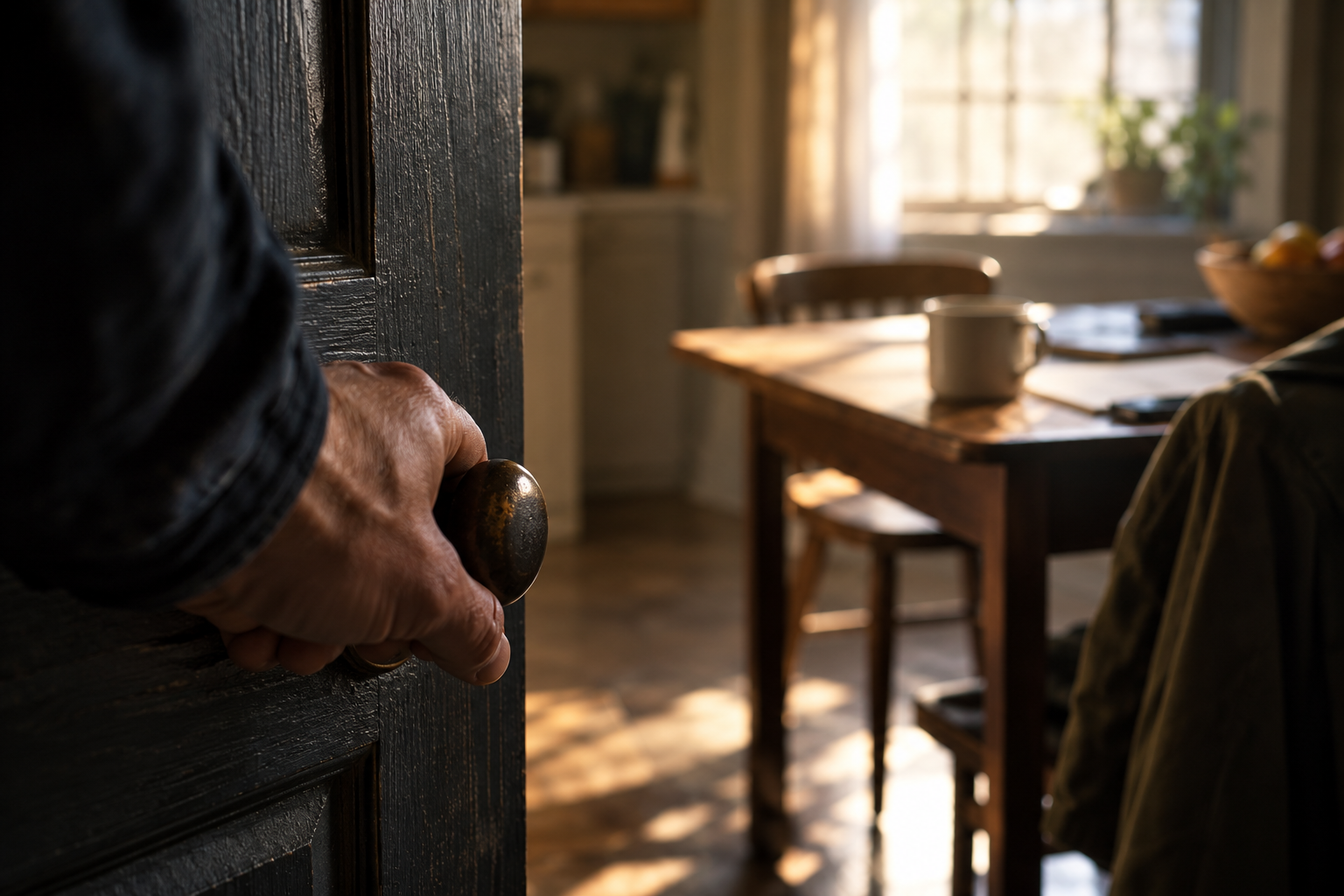
Picture an ordinary door. A kitchen door, an office door, the door of a diner at six in the morning. On the other side are people who know nothing about the traffic, the phone call, yesterday's argument, the good news, or whatever else you've been hauling since you got up.
None of us comes to a door empty-handed. We bring the day, and sometimes we bring years. Anger comes along. So does fear, and pride, and an old hurt we thought we'd put down somewhere. And now and then, grace.
We didn't choose everything we carried this far.
Your hand is on the knob. You stand there a second longer than you need to.
Then you go in.